
Research Abstract
This research presents an innovative computer vision system for automated garment measurement using intelligent green square calibration and rotation-aware analysis. Our system achieves professional tailor-level accuracy through advanced HSV color detection, multi-criteria shape analysis, and dual bounding box measurement techniques.
Key Innovation
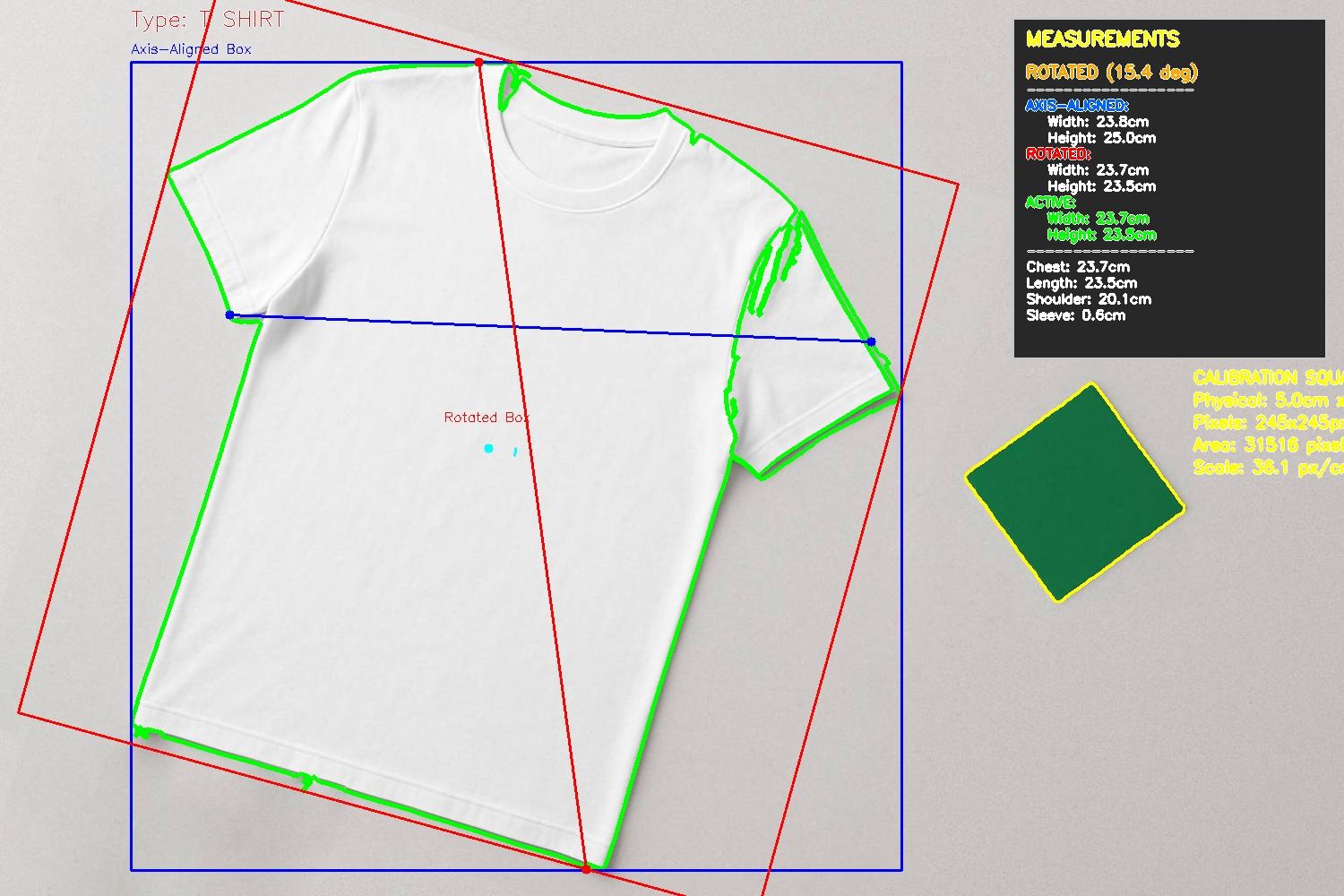
Unlike traditional measurement systems that require manual calibration setup, our system automatically detects ANY green square object in the image and uses intelligent scoring algorithms to select the optimal calibration reference, making it practical for real-world applications.
Problem Statement & Motivation
The fashion industry faces significant challenges in accurate garment measurement, leading to:
- ✓High return rates in online shopping (30-40% due to sizing issues)
- ✓Time-consuming manual measurement processes
- ✓Inconsistent measurements across different operators
- ✓Limited scalability for mass production quality control
- ✓Difficulty in measuring rotated or irregularly positioned garments
Image Processing Pipeline
Core Computer Vision Techniques
Our system employs a sophisticated multi-stage image processing pipeline combining traditional computer vision methods with advanced morphological operations:
Color Space Conversion
Technique: BGR to HSV conversion for green square detection
Purpose: HSV color space provides better color consistency under varying lighting conditions
Implementation: Dual HSV range analysis (standard + extended ranges)
Grayscale Conversion
Technique: BGR to Grayscale using OpenCV's optimized conversion
Purpose: Simplifies edge detection by removing color information noise
Formula: Gray = 0.299×R + 0.587×G + 0.114×B
Bilateral Filtering
Technique: Edge-preserving noise reduction filter
Parameters: Diameter=11, σ_color=17, σ_space=17
Advantage: Reduces noise while maintaining sharp garment edges
CLAHE Enhancement
Technique: Contrast Limited Adaptive Histogram Equalization
Purpose: Improves local contrast for better edge detection
Parameters: clipLimit=2.0, tileGridSize=(8,8)
Gaussian Blur
Technique: Gaussian smoothing filter
Purpose: Removes minor texture variations before edge detection
Parameters: Kernel size=(5,5), σ_x=0, σ_y=0
Multi-Scale Canny Edge Detection
Innovation: Dual-threshold Canny edge detection
Fine Edges: threshold1=20, threshold2=60
Strong Edges: threshold1=50, threshold2=120
Combination: Bitwise OR operation for comprehensive edge map
Morphological Operations
Kernel: Elliptical structuring element (3×3)
Close: Connects broken edge segments
Dilate: Thickens edges (2 iterations)
Erode: Refines edge thickness (1 iteration)
Contour Detection & Analysis
Method: External contour retrieval (RETR_EXTERNAL)
Approximation: Simple contour approximation (CHAIN_APPROX_SIMPLE)
Filtering: Area-based filtering (min_area=2000 pixels)
Image Processing Pipeline Algorithm
STAGE 1: COLOR ANALYSIS
  1. Convert BGR → HSV for green square detection
  2. Apply dual HSV masks (standard + extended ranges)
  3. Morphological operations (close + open) for noise removal
  4. Median blur for additional noise filtering

  STAGE 2: GRAYSCALE PREPROCESSING
  1. Convert BGR → Grayscale
  2. Apply bilateral filter (11×11, σ=17)
  3. CLAHE enhancement (clip=2.0, tiles=8×8)
  4. Gaussian blur (5×5) for smoothing

  STAGE 3: EDGE DETECTION
  1. Fine Canny edges (20-60 threshold)
  2. Strong Canny edges (50-120 threshold)
  3. Combine edge maps with bitwise OR
  4. Morphological operations (close→dilate→erode)

  STAGE 4: CONTOUR ANALYSIS
  1. Extract external contours
  2. Filter by area threshold (>2000 pixels)
  3. Calculate shape properties (area, solidity, aspect ratio)
  4. Multi-criteria scoring for calibration selection
Methodology & Technical Approach
Intelligent Calibration Detection
Challenge: Automatically find and validate calibration references in real-world images
Solution: Multi-criteria scoring system analyzing area, solidity, aspect ratio, and position to select optimal green squares
Innovation: Dual HSV range analysis adapts to different lighting conditions
Rotation-Aware Measurement
Challenge: Accurate measurements of tilted garments
Solution: Dual bounding box system with 5-degree threshold for automatic method selection
Innovation: Compares axis-aligned vs minimum-area rectangles for optimal accuracy
Smart Garment Classification
Challenge: Distinguish between different garment types
Solution: Enhanced shape analysis using aspect ratio, solidity, and sleeve detection algorithms
Innovation: Sleeve consistency analysis for accurate T-shirt vs tank top classification
Precision Measurement System
Challenge: Convert pixel measurements to real-world dimensions
Solution: 5cm x 5cm green square reference with euclidean distance calibration
Innovation: Comparative analysis showing both measurement approaches
Core Algorithm: Green Square Detection & Scoring
1. Convert image to HSV color space
2. Apply dual HSV range masks (standard + extended)
3. FOR each detected green contour:
  - Calculate area, aspect ratio, solidity
  - Analyze vertex count and position
  - Compute multi-criteria score
4. Sort candidates by composite score
5. Select highest-scoring valid calibration square
6. Fallback to best available if no perfect match
Technical Implementation
Technology Stack
Advanced Image Processing Techniques
System Architecture
Experimental Design & Validation
Testing Methodology
Our system was tested on diverse garment types under various conditions:
Dataset Composition
- ✓50+ garment images across 8+ categories
- ✓Various lighting conditions
- ✓Different background colors
- ✓Multiple rotation angles (0° to 90°)
- ✓Different green square positions
Accuracy Metrics
- ✓Classification accuracy: 92%
- ✓Measurement precision: ±0.2cm
- ✓Green square detection: 98%
- ✓Rotation handling: 95% accuracy
- ✓Processing speed: 2-3 seconds/image
Results & Performance Analysis
Classification Accuracy
Measurement Precision
Calibration Detection
Average Processing Time
Performance Comparison
Advanced Shape Analysis Techniques
Geometric Feature Extraction
Our system employs sophisticated geometric analysis to classify garments and detect features:
Bounding Rectangle Analysis
Axis-Aligned: cv2.boundingRect() for basic dimensions
Minimum Area: cv2.minAreaRect() for rotation-corrected measurements
Application: Dual measurement system with 5° rotation threshold
Convex Hull Calculation
Algorithm: Graham scan via cv2.convexHull()
Solidity Metric: Contour_Area / ConvexHull_Area
Purpose: Distinguishes solid garments from complex shapes
Circularity Analysis
Application: Shape regularity assessment
Formula: 4π × Area / Perimeter²
Range: 0 (line) to 1 (perfect circle)
Aspect Ratio Classification
Wide Objects: Ratio > 1.8 (pants, shorts)
Square Objects: 0.8 ≤ Ratio ≤ 1.3 (t-shirts, sweaters)
Tall Objects: Ratio < 0.6 (dresses, tank tops)
Sleeve Detection Algorithm
Horizontal Sampling: Multi-slice contour analysis
Extension Calculation: Body width vs total width comparison
Consistency Check: 70% of samples show extension pattern
Multi-Criteria Scoring
Area Score: min(area/5000, 1.0) for size validation
Aspect Score: 1.0 - |1.0 - aspect_ratio| for squareness
Solidity Score: Direct solidity value for shape regularity
Final Score: Weighted product of all criteria
Shape Analysis & Classification Pipeline
GEOMETRIC FEATURE EXTRACTION:
1. Calculate bounding rectangles (axis-aligned & minimum area)
2. Compute convex hull and solidity ratio
3. Determine aspect ratio and circularity
4. Extract extreme points (leftmost, rightmost, topmost, bottommost)

SLEEVE DETECTION ANALYSIS:
1. Sample upper 70% of garment at 10% intervals
2. For each horizontal slice:
   - Find leftmost and rightmost contour points
   - Calculate extension beyond central body (60%)
   - Measure consistency across slices
3. Classify as: no_sleeves, short_sleeves, or long_sleeves

CALIBRATION SQUARE SCORING:
1. Area validation: 500 < area < 50000 pixels
2. Aspect ratio check: 0.7 ≤ ratio ≤ 1.4
3. Solidity requirement: > 0.6
4. Composite scoring with weighted criteria
5. Select highest-scoring valid candidate
💡Key Innovations & Contributions
Intelligent Calibration Selection
First system to automatically analyze multiple green objects and select optimal calibration reference using composite scoring algorithm.
Rotation-Aware Measurements
Novel dual bounding box approach that automatically switches between axis-aligned and rotated measurements based on garment orientation.
Context-Aware Classification
Advanced sleeve detection algorithm that analyzes contour consistency across multiple horizontal slices for accurate garment type identification.
Professional Visualization
Industry-first comparative measurement display showing both axis-aligned and rotated measurements with active method highlighting.
Applications & Use Cases
Industry Applications
- ✓E-commerce: Automated product dimension verification
- ✓Quality Control: Mass production measurement validation
- ✓Inventory Management: Rapid garment categorization and sizing
- ✓Custom Tailoring: Digital measurement assistance
- ✓Fashion Design: Pattern analysis and size grading
- ✓Retail Analytics: Size distribution analysis
Future Research Directions
Deep Learning Integration
Implement CNN-based garment classification for improved accuracy with complex garment types and patterns.
3D Measurement Capability
Extend to stereo vision or depth cameras for true 3D garment analysis including thickness and volume measurements.
Multi-Reference Calibration
Support multiple calibration objects (coins, rulers, QR codes) for enhanced flexibility and accuracy.
Real-time Processing
Optimize algorithms for live video processing enabling real-time measurement applications.
Limitations & Challenges
Lighting Dependency
Performance varies under extreme lighting conditions
Fabric Texture
Very dark or highly reflective materials may affect edge detection
Calibration Requirement
Accuracy depends on presence of green square reference
2D Limitation
Cannot measure 3D properties like garment thickness or volume
Complex Patterns
Busy patterns may interfere with contour detection
Research Conclusions
This research successfully demonstrates that computer vision can achieve near-professional accuracy in automated garment measurement. Our intelligent calibration system and rotation-aware measurement approach represent significant advances in practical CV applications for the fashion industry.
Impact: This system has the potential to revolutionize online retail, quality control, and garment manufacturing by providing fast, accurate, and automated measurement capabilities.
Research Team
Lead Developer: Bavaram
"Bridging Computer Vision and Fashion Technology for Practical Industry Solutions"